
Grotto on Humeitepe
The Grotto on Humeitepe is one of two naturally formed grotto complexes within the city of Miletus. As its name suggests, the grotto is situated on a hill in the northern part of Miletus, near the Sanctuary of Demeter Sanctuary of Demeter. The grotto was uncovered in 1980 by Wolfgang Müller-Wiener during research work on this temple complex.
The site is a naturally formed grotto that was subsequently modified and extended. The interior is divided into two areas: a smaller chamber measuring 2.3 x 2.7 m, and a larger one adjoining it to the north-west, measuring 3.1 x 2.7 m. The entrance to the interior of the grotto is on the east side and leads initially into the larger chamber, where the rock forms a stepped formation. The ceiling heights within the grotto vary. Whilst the small chamber has a height of 1.60 m at the western wall, the larger chamber has a height of 2.89 m at the western wall. Originally, the grotto appears to have been partially covered by an overhanging rock ledge.

Photo: Huy 2019, 165 Abb. 18
Entrance to the grotto
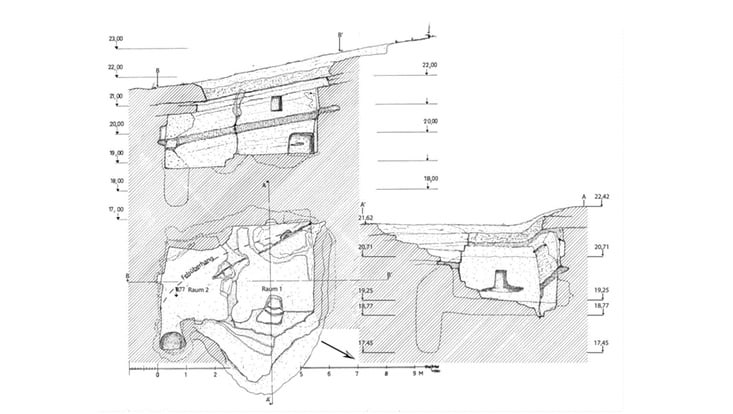
Photo: Huy 2019, 164 Abb. 15
Interior of the grotto, drawing after W. Müller-Wiener
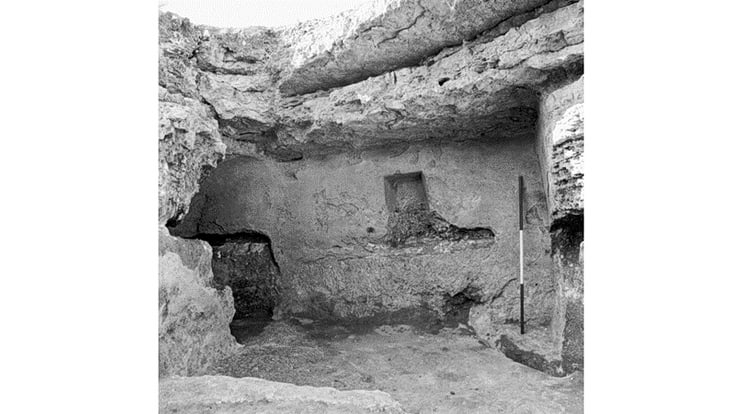
Photo: Huy 2019, 165 Abb. 19
Interior of the grotto with niche wall
It is difficult to date the grotto precisely, as the excavation records are incomplete. However, the finds from the grotto suggest a period of use that could date back at least to the Hellenistic period and continued into the Roman Imperial period. It is not possible to reconstruct a clear sequence of the individual phases of use. Nevertheless, various findings suggest that the grotto was expanded in stages. It is reasonable to assume that the interior initially remained in its natural state. It was probably only over time that the space underwent a more extensive decoration, which eventually included decorative elements such as the painted wall plaster of the grotto. This represents a development similar to that of the theatre grotto.
Particular significance can be attributed to the design of the rooms featuring niches. Terracotta objects and miniature hydriae were found in their immediate vicinity. Based on these findings, it's being debated whether the grotto was incorporated into the temenos of the Demeter sanctuary. The miniature hydriae in particular could point to such a connection, as around 200 of this type were found within the sanctuary. The miniature hydriae in particular might point to such a connection, as around 200 of this type were found within the sanctuary. However, this remains merely an assumption, as the actual extent of the temenos is uncertain.
As isolated finds of Islamic coins and glazed pottery have also been discovered, it appears that the cavity was only finally filled in during the Emirate period (c. 13th to 15th century AD), when Miletus was under the rule of the Menteşe Beylik.
Text: Milla Wefel
References
- S. Huy, Versteckte Orte. Zwei Grotten im städtischen Raum Milets, in: B. Engels – S. Huy – C. Steitler (Hrsg.), Natur und Kult in Anatolien. Viertes Wissenschaftliches Netzwerk an der Abteilung Istanbul des Deutschen Archäologischen Instituts, und F. Pirson – K. Piesker (Hrsg.), BYZAS 24. Veröffentlichungen des Deutschen Archäologischen Instituts Istanbul (Istanbul 2019) 145–176