
Grotto at the Theater
The so-called “Grotto at the Theater” is one of two naturally formed grotto complexes within the ancient city of Miletus. It is situated at the southern foot of the approximately 30-metre-high Kaletepe below the western parodos wall of the theater. The grotto was discovered in 1903 during work carried out under Theodor Wiegand. However, a more detailed investigation did not take place until 2013, when the interior of the grotto was systematically documented as part of research into the Byzantine city walls led by Philipp Niewöhner.
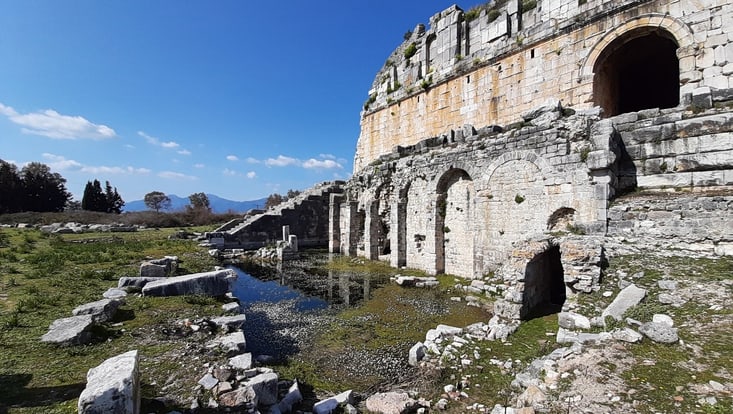
Photo: N. Cahenzli 2022
Grotto at the Theater from the south
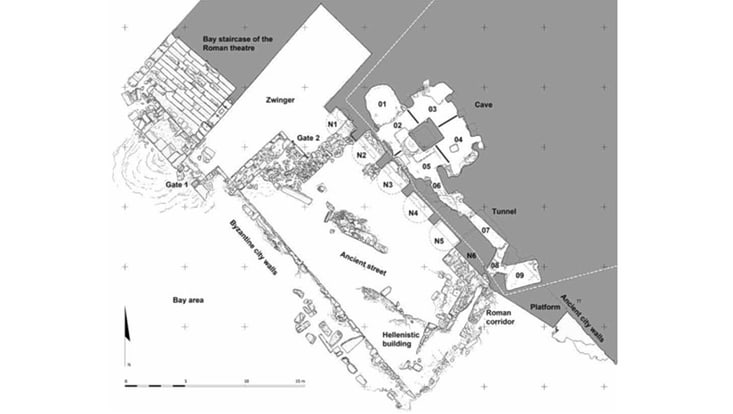
Photo: S. Giese 2016
Grotto at the Theater and area in front of it, plan after S. Giese
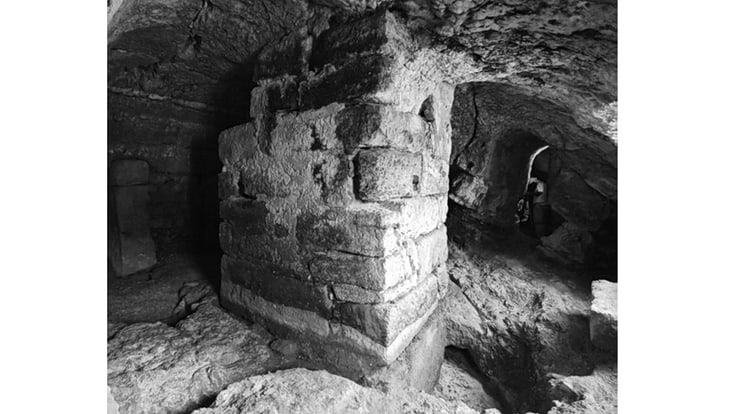
Photo: P. Niewöhner
Grotto at the Theater, main chamber
From the outside, the grotto is barely visible, as it is concealed behind the blind arcade façade of the theater. The entrance into the grotto is via an opening on the east side, next to which is a tunnel-like passageway of opus caementicium, built parallel to the façade. This leads via a staircase with nine steps into the interior of the grotto. Halfway up the staircase is a small rectangular room measuring 3 x 2 m. At the end of the staircase, just beyond a sharp left-hand bend, lies an approximately 8 m long passageway that opens into a larger main chamber. This chamber measures approximately 7.5 x 8 m and features a central supporting pillar, a spring as well as multiple niches. These include an apse-shaped niche in the north-west of the room, which is 2.7 m wide and 3.3 m deep. Archaeological finds indicate that the grotto was likely in use from the Hellenistic period onwards, with numerous objects dating to the 2nd century BC. Structural alterations, such as the expansion of the entrance and structural reinforcements, suggest continued use during the Roman Imperial period. These measures are likely linked to renovations to the theatre in the 2nd century AD. The exact function of the grotto has not yet been conclusively established. However, numerous finds, including over 200 terracotta fragments discovered in the grotto’s main chamber, suggest a cultic use. These fragments could be assembled to form approximately two life-sized figures as well as several other body parts. As natural springs were often regarded as sacred places in antiquity, it stands to reason that the grotto was involved in cultic practices during the Hellenistic and Imperial periods. The terracotta figures may have served as votive offerings, with a connection to healing deities such as Asclepius being discussed. The spring grotto was filled in at the beginning of the 5th century AD. The fill contained not only 44 late antique oil lamps but also marble sculptures from the theatre, which had probably already been damaged earlier, possibly by early Christians. The filling in of the spring therefore likely served two purposes: firstly, to put an end to the cult surrounding the grotto – probably as a consequence of, or in response to, the anti-pagan laws of the Theodosian emperors – and secondly, to protect the sacred spring and its votive offerings from further destruction or desecration.
Text: Milla Wefel
Literature
-
P. Niewöhner, An Ancient Cave Sanctuary underneath the Theatre of Miletus, Beauty, Mutilation, and Burial of Ancient Sculpture in Late Antiquity, and the History of Seaward Defences, AA, 2016/1, 67–156
-
S. Huy, Versteckte Orte. Zwei Grotten im städtischen Raum Milets, in: B. Engels – S. Huy – C. Steitler (Hrsg.), Natur und Kult in Anatolien. Viertes Wissenschaftliches Netzwerk an der Abteilung Istanbul des Deutschen Archäologischen Instituts, und F. Pirson – K. Piesker (Hrsg.), BYZAS 24. Veröffentlichungen des Deutschen Archäologischen Instituts Istanbul (Istanbul 2019) 145–176